


Syllabus: GS3/ Economy
Context
- The recent White Papers released by the Kerala and Tamil Nadu governments have highlighted the growing fiscal stress faced by State governments despite their strong social and economic development.
Rising Public Debt of States
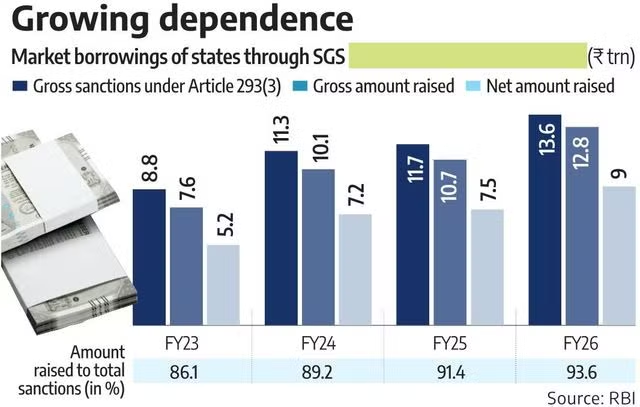
- According to the Reserve Bank of India’s Annual Report 2025–26, States raised ₹12.76 lakh crore through State Government Securities (State Development Loans—SDLs) during 2025–26, compared to ₹10.73 lakh crore in 2024–25.
- Market borrowings financed 76.3% of States’ gross fiscal deficit, up from 71.8% in the previous year.
- The sharp increase in State borrowings has widened the spread between State Development Loans (SDLs) and comparable Central Government Securities (G-Secs).
- The weighted average cut-off yield on SDLs increased to 7.32% in 2025–26, compared to 7.20% in 2024–25.
Why are State Governments Facing Fiscal Stress?
- Developmental Responsibilities: State governments are responsible for delivering essential public services such as healthcare, education, irrigation, urban and rural development and public welfare.
- Also growing population, urbanisation and rising public expectations have significantly increased expenditure on social and economic sectors.
- Limited Revenue Mobilisation: States rely mainly on the State Goods and Services Tax (SGST), State Excise Duty, Stamp Duty and Motor Vehicle Tax for their own revenues.
- Dependence on Union Transfers: The state governments are dependent on centre for tax devolution, finance Commission grants, centrally Sponsored Schemes and loans.
- However the states have raised their concerns regarding insufficient devolution of tax and conditional grants.
- Borrowing for Current Expenditure: The CAG report flagged a breach of the ‘golden rule’ of borrowing, which says governments should raise debt only for investment, not to fund operating costs.
- CAG found in 11 states (Punjab, Tamil Nadu, West Bengal, Andhra Pradesh, etc.), more than half of net borrowings were used for salaries, pensions, subsidies rather than infrastructure.
Measures Needed to Strengthen State Finances
- Fiscal Federalism: States should receive enough fiscal resources to fulfill their expenditure responsibilities. It will improve their ability to design development programmes according to local needs.
- Increase Capital Expenditure: States should prioritise investments in infrastructure, education, healthcare, research, renewable energy and digital infrastructure.
- Greater capital expenditure enhances productivity and creates long-term economic benefits.
- Reduce Borrowing Costs: Measures to lower the borrowing cost of State Development Loans can provide additional fiscal space for development projects.
- Public Financial Management: Better project planning, timely implementation, outcome-based budgeting and transparency can improve the efficiency of public expenditure.
- Public-Private Partnerships: Private sector participation will supplement public investment in infrastructure and reduce fiscal pressure on State governments.
Concluding remarks
- Strong State finances are indispensable for achieving inclusive growth, balanced regional development and effective governance.
- A balanced approach that combines prudent debt management with sustained investment in human capital and infrastructure will enable States to become stronger engines of India’s long-term economic development.
Legal & Institutional Framework managing Public Debt in India
- Public Debt Act, 1944: Governs procedural aspects of debt issuance and management, though outdated for modern markets.
- Fiscal Responsibility and Budget Management (FRBM) Act, 2003: Sets fiscal deficit and debt targets, requires transparent reporting, and promotes medium-term strategy.
- Provides a framework for fiscal discipline, targeting:
- Central Govt debt: 40% of GDP
- General Govt debt: 60% of GDP
- Provides a framework for fiscal discipline, targeting:
- Government Securities Act, 2006: Regulates issuance, trading, and management of government securities.
- RBI Act, 1934: Sections 17, 20, 21, and 21A mandate RBI to manage Central and State government debt, issue loans, and handle securities.
Article 293(3) of the Constitution of India
- Article 293 deals with the borrowing powers of State Governments.
- It states that, if a State is indebted to the Government of India, or if any loan made by the Government of India to the State is still outstanding, the State cannot raise any further loan without the consent of the Government of India.
Previous article
10 Years of Pradhan Mantri Krishi Sinchayee Yojana (PMKSY)
Next article
Nine Years of GST
